The Doom Engine

This is a Solo RPG Escalation System for Hidden Threats, Political Intrigue, Disasters, and Big Bad Events. Part of a Game Master’s role is to develop these unseen threats, foreshadow clues, and eventually spring the event. In Solo play, we run directly into the issue of the Player knows vs what the Player Character (PC) knows, and frankly, as a player, sometimes I want to be surprised. This system is designed to accomplish precisely that.
1. Overview
The Doom Engine models “rising tension” from unseen threats. As the story progresses, player(s) gain cryptic clues as danger builds to the eruption of a decisive “event.” The system is designed for solo or cooperative play. Provisions are made to integrate naturally with any 2d6 Traveller-style mechanics.
The intent is for a typical arc to provide 3–6 clues before eruption.
2. Core Concepts
Each Doom Engine represents one threat vector (monsters, personal, political, environmental, magical, cosmic, …)
Periodic Doom Checks determine whether the threat advances or erupts.
Each success yields a clue and increases danger.
Failure triggers the event immediately.
3. Doom Engine Setup
At the start of an arc:
Doom Rating (DR): 2
Dice: 2d6
Success if DR ≤ roll (Gain one d66 clue, Increase DR by 2, max DR = 8)
Failure if DR > roll (Big Bad Event triggers immediately.)
Failure if DR > roll (Big Bad Event triggers immediately.)
4. When to Roll Doom Checks
Roll a Doom Check at major narrative beats.
A scene ends
Time passes
The party rests or travels
A major objective is completed
5. Player Countermeasures
Player countermeasure points (CPs) can be used to delay, soften, or redirect events. Players begin each arc with 2 Countermeasure Points (CP), max CP = 5.
Gaining CP:
Acting on clues
Gathering intelligence
Preparing defenses
Spending CP:
1 CP – Shift check to lowest DR Doom Engine (See “Running Multiple Doom Engines.”)
1 CP – Add -1 DR for one check
2 CP – Auto success; gain two clues
2 CP – Deflect a triggered event
3 CP – Gain advantage on first response roll
CP can delay, soften, or redirect a threat vector, but never cancel it entirely.
6. d66 Clue Table
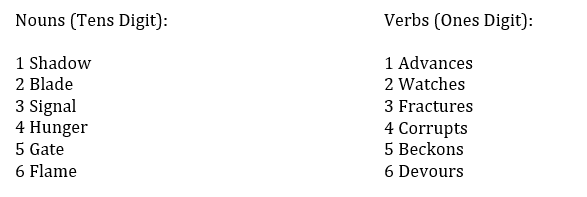
Example Clues:
12: Shadow Watches
64: Flame Corrupts
36: Signal Devours
55: Gate Beckons
Clues should feel ominous but incomplete.
7. Interpreting Clues
Each clue hints at actor, method, or intent. Interpret each clue symbolically or literally. Clues should feel ominous but incomplete.
When a clue appears, generate the noun-verb pair. A preliminary interpretation is encouraged, if only to get the creative juices flowing, but delay final interpretation until the event is triggered. It may be that your final interpretation, arrived at by meshing the individual clues together, is far different from what you expected.
Ask:
Is this clue literal, symbolic, or misdirecting?
Does it point to a person, place, faction, or method?
Does it suggest timing, intent, or means?
Clues should not fully explain the event—they create dread, not certainty.
8. Triggering the Event
When a Doom Check fails, the Big Bad Event occurs immediately
The GM (you, as solo player) constructs the event using all accumulated clues and the current situation. Combine all clues to define the most threatening interpretation that still feels fair. (Who, what, when, where, and how?)
The event does not replace existing threats—it escalates or reframes them. The event should feel surprising but inevitable in hindsight.
9. Optional Variants
Faster Burn: Short arcs, brutal pacing
Start DR at 4
Increase DR by three on each success
Longer Mystery:
Start DR at -2
Use 1d12
Increase DR by one every two successes
Player Pressure:
If the party takes reckless action, make an extra Doom Check
If they prepare defensively, skip the next check
The Obvious, the Other, the Outlandish:
This rule is here to shake up the interpretation that has already started forming in the back of your mind. The entire tool is intended to inject surprise into solo play, but not so much that the work so far gets thrown out the window.
When the event is triggered, test your initial interpretation of each clue.
Roll 1d6, 1-3 The Obvious (No change to interpretation), 4-5 The Other (Modify your interpretation of this clue), 6 – The Outlandish (Your initial interpretation of the clue was entirely off base.)
At the first instance of “Outlandish” (die roll 6), stop testing the remaining clues.
10. Multiple Doom Engines and Fusion Rules
Run 2–3 Doom Engines at once.
One Primary (checked every scene)
Others Secondary (checked intermittently)
Countermeasures are shared but applied to specific engines.
Fusion occurs when threats entangle.
Fusion Triggers:An engine erupts
Two engines reach DR 8
Clues overlap
Fusion Check: Roll 2d6
2–5: No fusion
6–8: Soft Fusion
9–11: Hard Fusion
12: Total Fusion
Soft Fusion: Engines interfere; DR –1 or higher CP costs. “These problems are starting to overlap.”
Hard Fusion: One engine subsumes another; combine clues.
Total Fusion: Create a new fused engine, a super threat with combined clues.
11. Design Intent
The Doom Engine emphasizes tension, agency, and the emergence of narrative. The intent is a modular, system-agnostic tool optimized for solo roleplaying.